
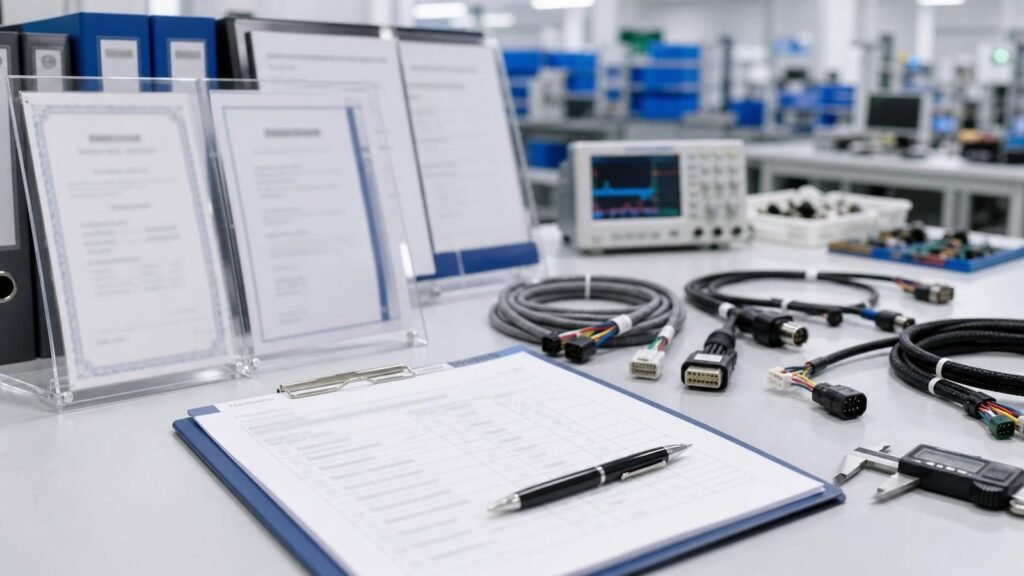
Medical cable assemblies are custom-manufactured electrical interconnects designed, tested, and documented for use inside or in close proximity to medical devices and patient environments. Sourcing the correct medical cable assemblies requires understanding three intersecting requirements: patient safety (IEC 60601-1 leakage current limits), material biocompatibility (ISO 10993), and quality system compliance (ISO 13485). Each of these shapes the design, production, and documentation of every medical cable assembly in a clinical supply chain.
At Nexharn Connectivity, we manufacture medical cable assemblies under an ISO 13485-aligned quality management framework, covering design review, material traceability, in-process inspection, and FAI (First Article Inspection) reports. Our medical cable manufacturer overview covers our full capability, and the medical cable solutions industry page provides application-specific product guidance.
What Are Medical Cable Assemblies
Medical cable assemblies encompass a wide range of product types: patient monitoring cables (ECG lead wires, SpO₂ sensor extension cables, NIBP hose assemblies with integrated wiring), surgical instrument cables, diagnostic imaging cables (ultrasound transducer assemblies), and hospital-grade power cords for IEC 60601-1 classified equipment. Each category carries distinct design constraints covering connector types, insulation class, strain relief pull-force, sterilization method, and biocompatibility screening requirements.
Unlike industrial or consumer cables, medical cable assemblies must satisfy regulatory requirements at three levels: the cable assembly itself (materials, electrical performance), the quality management system behind its manufacture (ISO 13485 design and production controls), and the documentation traceability required by the device OEM’s Design History File (DHF) or Technical File for CE marking.
Standards & Compliance
ISO 13485: Quality Management for Medical Devices
ISO 13485:2016 defines quality management system requirements for organisations in the medical device supply chain. For a medical cable assemblies manufacturer, ISO 13485 certification means the QMS addresses design and development controls, purchasing controls (raw material supplier qualification), production controls (work instructions, traceability), non-conformance handling, and post-market surveillance. When you source medical cable assemblies from an ISO 13485-certified supplier, you can incorporate their QMS documentation into your Design History File with confidence.
IEC 60601-1: Electrical Safety for Medical Equipment
IEC 60601-1 is the overarching safety standard for medical electrical equipment. For applied parts (cables making physical contact with the patient), it defines maximum allowable leakage currents: 10 μA for BF-type and 10 μA for CF-type (cardiac-floating) applications under normal condition. Medical cable assemblies for patient-connected devices must be designed with correct conductor cross-section, insulation class, and connector creepage/clearance to maintain these limits under single-fault conditions. IEC 60601-1 Clause 15 also requires applied-part cables to withstand a 50 N pull force without connector separation.
ISO 10993: Biocompatibility
ISO 10993 is a series of standards governing the biological evaluation of medical device materials. Parts 1 (risk framework), 5 (cytotoxicity), 10 (sensitization and irritation), and 17 (toxicological risk assessment for leachables) are most relevant to medical cable assemblies with direct skin contact. Biocompatibility requires that jacket and overmould materials are free from DEHP phthalate plasticizers, latex, bisphenol A, and other substances with known sensitization profiles. ISO 10993-compliant material data sheets from resin suppliers form part of the biocompatibility documentation file required for EU MDR and FDA 510(k) submissions.
Additional Regulatory Standards
- IEC 60601-1-2: EMC requirements for the medical electromagnetic environment — affects shielding specification of medical cable assemblies
- UL 2111 / UL 544: North American safety requirements for medical equipment power supply cords and patient-lead cables
- EU MDR 2017/745: Cable assemblies used as accessories to medical devices require a Declaration of Conformity and traceability documentation for the device technical file
Material Selection
Medical-Grade Silicone
Platinum-catalysed silicone rubber is the preferred jacket material for medical cable assemblies requiring autoclave sterilization (121–134 °C), continuous skin contact, or use in high-flex surgical applications. Medical-grade silicone (USP Class VI / ISO 10993-5 compliant grades, e.g., NuSil MED-6015, Wacker SilGel 612) remains flexible at −60 °C and resists UV and ozone degradation. The trade-off is higher cost and lower abrasion resistance compared to thermoplastic alternatives — acceptable where biocompatibility and sterilization tolerance are the primary requirements.
Medical-Grade TPU (Thermoplastic Polyurethane)
TPU is the workhorse material for patient monitoring medical cable assemblies — ECG lead wires, SpO₂ cables, NIBP cords. Medical-grade TPU (e.g., Lubrizol Pellethane 2363 series, BASF Elastollan medical grades) meets ISO 10993-5 cytotoxicity and ISO 10993-10 sensitization requirements. It offers excellent abrasion resistance for cables coiled and uncoiled hundreds of times per day, hydrolysis resistance, and a wide colour range for lead-wire identification coding. TPU cannot withstand steam autoclave sterilization but handles EtO and H₂O₂ plasma cycles without degradation.
DEHP-Free PVC (Restricted Use)
DEHP-plasticised PVC is being phased out of direct-patient-contact applications under EU MDR Annex I essential requirements and REACH SVHC restrictions. Where PVC is specified for non-patient-contact cables (equipment-to-equipment interconnects, power cords), DINP or DINCH-plasticised medical-grade grades should be substituted.
PTFE / FEP Fluoropolymers
Fluoropolymer insulation is specified for medical cable assemblies that must resist aggressive chemical disinfectants (chlorhexidine, sodium hypochlorite wipes) or where operating temperature exceeds the silicone flex range. PTFE/FEP-insulated conductors are used in high-flex surgical robotics cables where insulation must maintain dielectric integrity over millions of flex cycles in articulating instrument shafts.
Sterilization Considerations
The sterilization method must be defined at the design stage of any medical cable assembly — changing jacket material after clinical validation is costly and time-consuming.
| Method | Temperature | Compatible Jacket | Key Considerations |
|---|---|---|---|
| Steam autoclave 121 °C | 121 °C, 15–30 min | Silicone | Connector housings: PEEK or PSU — Nylon 6 hydrolyses |
| Steam autoclave 134 °C flash | 134 °C, 3 min | Silicone (premium grades) | Limits to 200–500 cycles depending on connector overmould |
| Ethylene oxide (EtO) | 37–60 °C | Silicone, TPU, PTFE, PVC | Aeration 8–24 h; jacket permeability must support EtO penetration |
| H₂O₂ plasma (Sterrad) | < 50 °C | Silicone, TPU, PTFE | Not suitable for absorbent materials; connector lumen must allow vapour penetration |
| Gamma irradiation | Ambient | Silicone, PTFE | TPU can yellow or embrittle at high dose; shielding review required |
| Chemical wipe (IPA, bleach) | Ambient | Most materials | Repeated bleach exposure degrades certain TPU and PVC grades |
Applications
Diagnostic and Patient Monitoring
The highest-volume segment for medical cable assemblies is patient monitoring. ECG lead wire sets (3-lead, 5-lead, 10-lead / 12-lead), pulse oximetry extension cables, NIBP cuff assemblies, and temperature probe cables are consumed in large quantities by hospitals and are frequently replaced due to daily handling damage. For this segment, TPU jacket with IEC 60601-1 BF or CF applied-part compliance, colour-coded lead identification, and compatibility with AHA/IEC banana or DIN 42802 connectors are the key design criteria. Visit our medical cable solutions page for application-specific capability.
Surgical Devices
Laparoscopic, robotic-assisted, and electrosurgical instrument cables require high flex-cycle endurance (typically >1,000,000 cycles at 180° bend), compatibility with repeated sterilization, and RF shielding where electrosurgical energy is transmitted. Silicone jacket with PTFE-insulated conductors and over-moulded strain relief is the standard construction for these medical cable assemblies.
Imaging and Ultrasound Transducers
Ultrasound transducer cables carry both low-voltage receive signals (sub-mV) and high-voltage transmit pulses (up to 200 V peak). Construction requires individually shielded coaxial elements within a multi-lumen array — typically 128 or 256 channels — terminated in micro-pitch connectors. These are among the most technically demanding medical cable assemblies and typically require custom tooling investment.
Custom Manufacturing & OEM Options
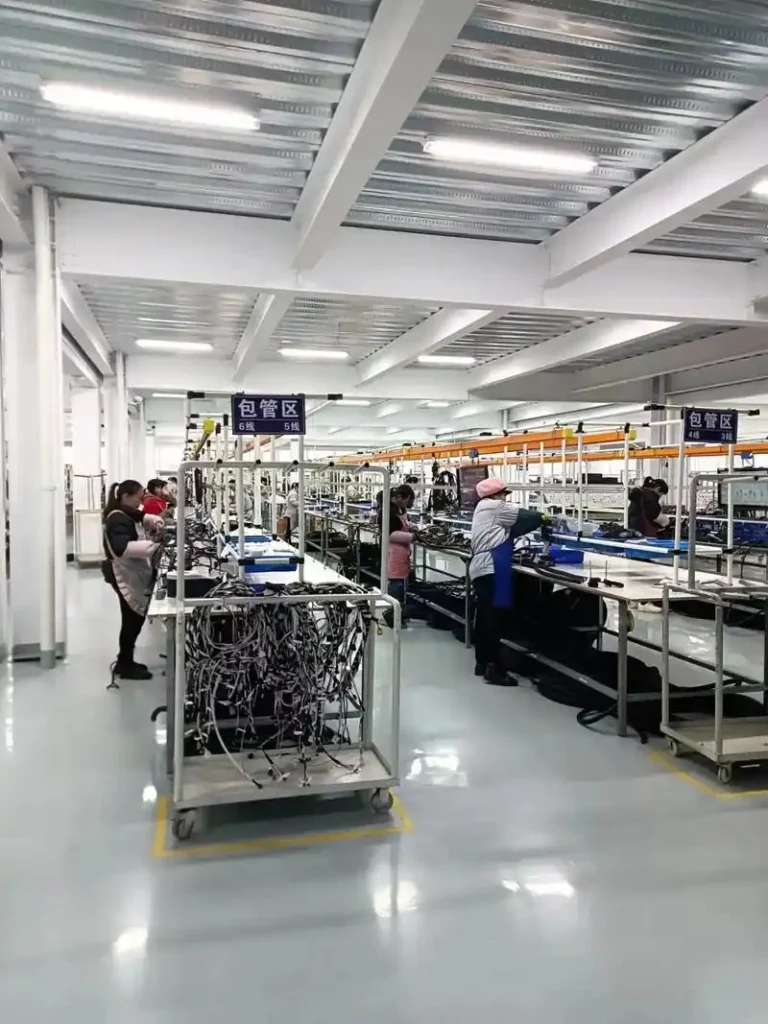
Nexharn Connectivity supports medical device OEMs through the full development cycle for custom medical cable assemblies. Our hospital procurement compliance guide covers the supplier qualification framework in detail.
- Design review: Material selection guidance, sterilization compatibility review, IEC 60601-1 applied-part classification advice based on your device classification
- Prototype / FAI: 3–10 pcs, 10–15 business days. Full First Article Inspection report: dimensional check, pull test (50 N minimum), continuity, insulation resistance
- Biocompatibility file: Resin supplier ISO 10993-5/-10 test reports; additional biological evaluation testing arranged through accredited third-party labs on request
- Traceability: Lot-coded production with full batch records — conductor reel number, jacket extrusion lot, connector mould cavity ID, operator ID, test result per piece
- QC inspection: IQC (incoming material certification), IPQC (extrusion OD, concentricity), OQC (100% electrical test, pull test, AQL 0.65 visual)
MOQ, Lead Time and Sample Policy
- Prototype: 3–10 pcs, no MOQ, 10–15 business days
- Production MOQ: 50 pcs per part number (100 pcs for moulded connector assemblies requiring dedicated tooling)
- Standard lead time: 20–30 business days after golden-sample approval
- Annual blanket orders: Available for MedTech OEMs with predictable volume — reduces unit cost 10–18% versus spot orders
To discuss your medical cable assembly project, contact our engineering team via the RFQ and contact page. Upload a drawing or specification sheet for a faster, more accurate quotation.
FAQ
Does Nexharn hold ISO 13485 certification?
Nexharn Connectivity operates under an ISO 13485-aligned quality management system covering design control, supplier qualification, production control, and non-conformance management. Our factory supports third-party audits and provides QMS documentation packages — SOPs, process FMEA, and control plans — to support customer Design History File requirements for medical cable assemblies.
What materials do you recommend for medical cable assemblies that must be autoclaved?
Platinum-catalysed silicone rubber jacket with silicone-overmoulded connector strain relief is the standard recommendation for autoclavable medical cable assemblies. Conductors are silver-plated copper to resist steam-induced oxidation. Connector housings should be PEEK, PSU (polysulfone), or PPS — not ABS or Nylon 6, which hydrolyse after repeated steam autoclaving.
Can you supply medical cable assemblies compliant with EU MDR 2017/745?
Yes. As a component supplier, we provide: (1) Declaration of Conformity for applicable directives (RoHS 2, REACH SVHC); (2) ISO 10993-5/-10 biological evaluation reports for patient-contact materials; (3) material traceability documentation; and (4) production batch records for inclusion in your technical file.
What is your typical lead time for medical cable assembly samples?
Standard prototype lead time for medical cable assemblies is 10–15 business days from receipt of an approved drawing and confirmed material specification. Rush prototypes (5–7 days) are available for straightforward constructions using in-stock materials.
Can you replicate an existing OEM cable for replacement?
Yes, provided you hold the rights to specify the replacement. We require a sample of the existing medical cable assembly for dimensional reverse-engineering, the applicable electrical and mechanical specifications, and confirmation of authorisation. We do not manufacture cables bearing third-party brand names or trademarks.
Do you support EtO sterilization validation for medical cable assemblies?
We do not operate EtO sterilization chambers, but we provide material compatibility data and coupon samples for your validation laboratory’s EtO cycle testing. We also supply aeration permeability data for the jacket materials so your validation team can establish the required aeration hold time.