
Quick answer: Specify a power tool coiled cable by sharing the tool’s electrical requirements, full movement path, relaxed and working reach, likely abrasion points, connector references, and termination details. A coiled construction can help manage a moving connection, but suitability depends on the actual tool, duty cycle, routing, and cable design; confirm these with engineering before approval.
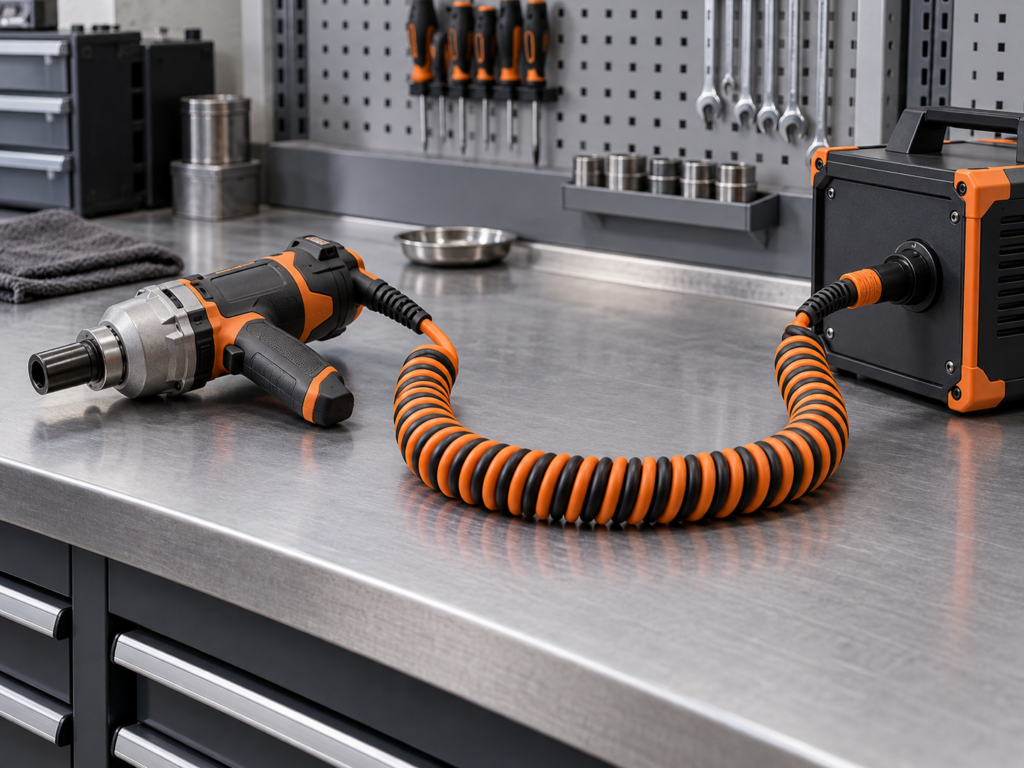
What should a buyer define before requesting a sample?
Start with the tool and its operating environment, not only a target cable length. Tell the supplier whether the coiled lead carries power, control signals, or both; how the operator moves the tool; where the cable anchors; and how it is stored when not extended. Share a drawing, photos, or a marked-up routing sketch if available.
Electrical load and conductor selection
Provide the tool’s documented voltage, current or power requirements, circuit functions, conductor count, and preferred wire gauge if already specified. If the electrical design is still open, send the equipment requirements and ask for an engineering review. Do not infer a safe wire gauge or rating from the tool’s appearance or from the number of cores alone. Any proposed construction should be checked against the actual electrical load, cable length, ambient conditions, and applicable equipment requirements.
- Identify power, signal, ground, and control circuits separately.
- Share the required conductor count and any wire gauge already approved by your electrical team.
- Provide connector part numbers, mating-side references, pinout, and termination method.
- State whether shielding is needed and how it should be connected at each end.
Map reach, recoil and the tool-side route
Measure the relaxed length and the normal working extension between fixed points. Also show the maximum required reach, the available space for the coil, straight tails at both ends, and the location of strain relief. A single “extended length” value may not describe repeated movement: include the path, direction changes, storage position, and any stops that limit travel.
For handheld tools, pay particular attention to where the lead exits the handle, whether it can snag on a work surface, and how the operator’s movement changes the pull angle. If the tool is used in a fixture or work cell, show the complete equipment-side routing. Return behavior, extension force, and coil geometry should be reviewed against the actual use case rather than assumed from a generic ratio.
Abrasion, heat and environmental exposure
Mark likely rubbing and impact points, nearby sharp edges, moving joints, dust, oils, cleaning agents, and other exposures. Identify whether the cable touches the tool housing or workpiece during normal operation. These details help the supplier assess jacket material, coil placement, protective routing, and strain relief, but they do not establish a specific abrasion, temperature, chemical, or service-life rating. Request evidence or project-specific validation for any required performance claim.
Connectors, terminations and strain relief
Send connector manufacturer and part numbers where possible, plus clear photos of both mating halves. Specify which side is tool-side and supply-side, the pin numbering viewpoint, wire colors if fixed, and any overmolding or boot envelope constraints. Confirm cable exit direction and bend clearance so the termination does not interfere with the grip, trigger, guard, or tool storage.
Sample review and inspection points
Before a sample is built, agree what will be reviewed: relaxed length, working reach, coil outside diameter, straight tails, connector fit, pinout/continuity, visual finish, and packaging. Define the measurement method and acceptance limits together. A sample approval should record the actual drawing revision and any deviations; do not treat a visual fit check as proof of electrical or durability performance.
Common RFQ mistakes
- Sending only a cable length without showing the fixed points or movement path.
- Leaving out current, circuit function, conductor count, or an approved gauge.
- Using “durable” or “heavy duty” without identifying actual abrasion or operating conditions.
- Providing a connector photo without its part number, pinout, or mating-side orientation.
- Assuming a sample proves a rating or life requirement that was never tested or agreed.
Buyer checklist for a power tool coiled cable
- Tool model, application, and whether the cable carries power, signal, or both.
- Electrical requirements and confirmed conductor/gauge information.
- Relaxed length, normal and maximum working reach, coil space, and straight tails.
- Movement path, anchor points, bend direction, and storage condition.
- Abrasion/contact locations and relevant environmental exposures.
- Connector references, pinout, shielding/grounding, and termination constraints.
- Sample quantity, drawing revision, inspection points, and packaging needs.
Related cable options and engineering review
Review the existing coiled cable options for power tools for the application-specific product overview. For material and construction choices across the range, see custom TPU coiled cable configurations. The TPU coiled cable RFQ checklist can help organize dimensions and movement details before you submit.
Request an engineering review
Send the tool application, documented electrical requirements, conductor count, relaxed length, normal working reach, connector references, pinout, shielding needs, abrasion points, and estimated quantity. Drawings and sample photos are welcome. Upload your RFQ and supporting files for project review. Final construction and acceptance criteria are confirmed for each design.