
Quick Answer: Specify a massage chair coiled cable from the handset circuit, the cable route through every chair position, required user reach, stored coil location, connector pinout and pinch-point limits. Review the sample on the actual chair or a representative frame before approving the route.
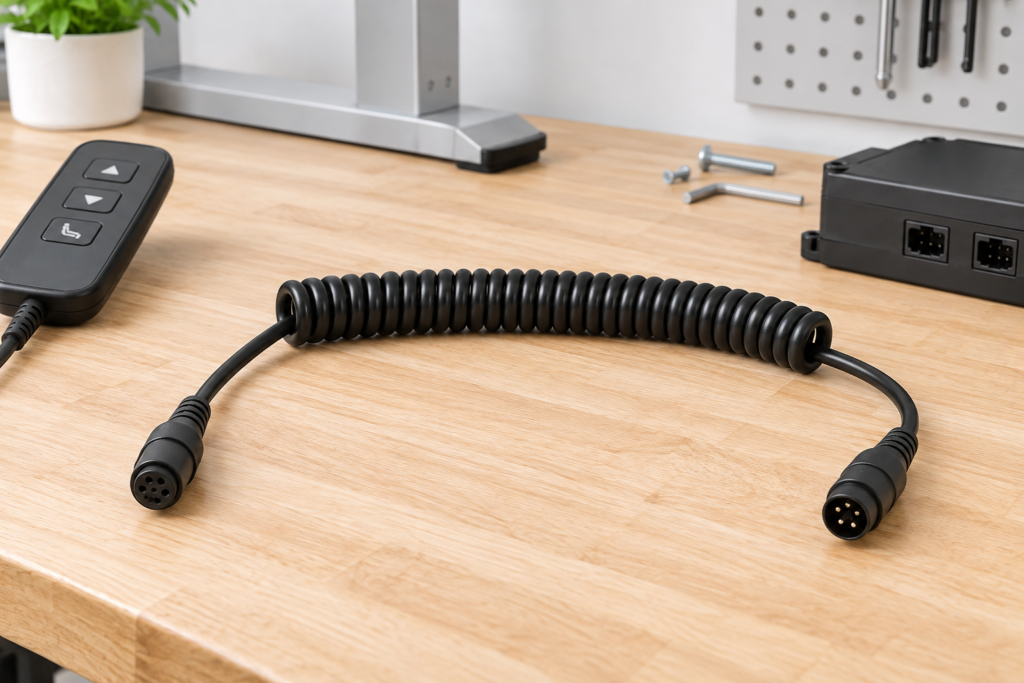
Why the Cable Route Matters on a Moving Chair
A handset lead may move as a chair reclines, lifts, returns upright or is stored. The shortest distance measured in one position does not describe the full route. A cable that is comfortable when the chair is upright can become trapped near a hinge, stretched across an actuator path or pulled against the controller when the furniture moves.
For a custom massage chair cable, the buyer should show the control box, handset, mounting points and the full motion path. If the cable passes through a frame opening, include its dimensions and edge condition. Do not assume that a coil alone prevents snagging or pinch damage.
Quick Answer: What Should a Buyer Measure?
Record the relaxed cable length, the normal working reach, the maximum position that is part of intended use, the straight tails at both ends and the available coil storage space. Measure the route with the chair in upright, reclined and stored positions. Identify any intermediate position where the cable could touch a moving linkage.
- Handset reach: Measure from the cable exit at the control box to the handset entry at each user position.
- Movement path: Mark the route through the complete recline or lift travel, not just the end points.
- Coil space: Provide the maximum coil outside diameter and the space available when the chair is stored.
- Straight tails: Specify end lengths, exit directions and where the first coil may begin.
- Return force: State whether the user holds the handset, places it in a cradle or leaves it on the chair; excessive pull can affect handling.
Electrical and Connector Inputs for RFQ
List each circuit function from the wiring diagram: power, control, communication or other signals. State the conductor count and gauge requested, but have the complete current, voltage, cable length and connector construction reviewed together. Core count alone does not establish whether a design is electrically suitable.
Provide the handset and controller connector part numbers, mating interface, keying, pinout, contact arrangement and cable exit direction. If the chair has several handset versions, identify the model or revision for each. A photo can help identify the connector body, but it cannot replace a wiring diagram when the pin assignment is safety- or function-critical.
Shielding should be requested only with the signal and grounding purpose explained. Include where the shield is terminated, whether a drain wire is required and how the connector shell is bonded. The cable supplier should review the electrical interface and proposed construction before a sample is approved.
Routing Risks to Review on the Furniture
Walk through the complete intended motion while observing the cable, not only the controller display. Check frame gaps, hinge edges, actuator arms, upholstery movement and the places where the handset is docked. Confirm the cable does not bear the handset’s weight or become the travel stop for a moving part.
- Pinch or shear points at hinges and frame joints
- Contact with sharp edges, fasteners or moving linkages
- Excess slack that can drag on the floor or enter a mechanism
- Insufficient slack that pulls the connector or handset
- Coil interference with the handset cradle or furniture cover
- Cleaning agents, oils or other substances that may contact the jacket
Tell the manufacturer what cleaning products and environmental exposure are expected. Material compatibility depends on the selected jacket formulation and exposure conditions; do not treat “TPU” as a blanket chemical-resistance guarantee.
How to Review a Sample
Agree the inspection criteria before the sample is built. On the intended furniture or a dimensionally representative fixture, check connector fit and keying, pinout and continuity against the approved drawing, relaxed length, normal reach, coil clearance and cable routing through the motion range. Observe whether the return force is acceptable for the user and whether the first coil or straight tail contacts the enclosure.
Record the chair model, drawing revision, measurement points and pass/fail criteria. If a sample change is requested, update the drawing or written specification so the approved configuration is unambiguous. Testing beyond the agreed checks should be defined by the buyer and engineering team; no fixed cycle-life or environmental result should be assumed without a specified method and evidence.
Common RFQ Mistakes
- Providing only the maximum reach, without the relaxed length or stored position
- Measuring with the chair in only one position
- Omitting frame openings, hinge paths and pinch zones from the drawing
- Sending a connector photo without part number, pinout or wire-function mapping
- Specifying “soft return” without describing the handset weight and use pattern
- Changing a chair or controller revision after sample approval without updating the cable drawing
Buyer Checklist Before Sample Approval
- Chair/recliner/adjustable-bed model and control-box revision
- Wiring diagram, conductor functions, requested gauge and electrical requirements
- Connector part numbers, pinout, keying and exit direction
- Relaxed length, normal working reach, straight tails and coil-space envelope
- Photos or drawing showing upright, full-travel and stored cable routes
- Pinch-point, abrasion, cleaning-fluid and other environment notes
- Sample quantity, annual demand, label and packaging requirements
- Written inspection criteria for routing, continuity, dimensions and connector fit
Related Product and Engineering Resources
For a product-specific starting point, review Massage Chair and Electric Furniture Coiled Cable. For the general relationship between relaxed length, working reach and extension force, see the TPU coiled cable working-reach guide. Compare other constructions in the TPU coiled cable product range.
Request an Engineering Review
Send the chair model, control-box and handset references, circuit functions, relaxed length, normal working reach, frame-route photos, connector details and sample quantity. If a complete drawing is not ready, start with photos and the measurements available; the missing RFQ inputs can be identified before sample approval.