
TPU coiled cable manufacturer | Compare TPU coiled cable applications
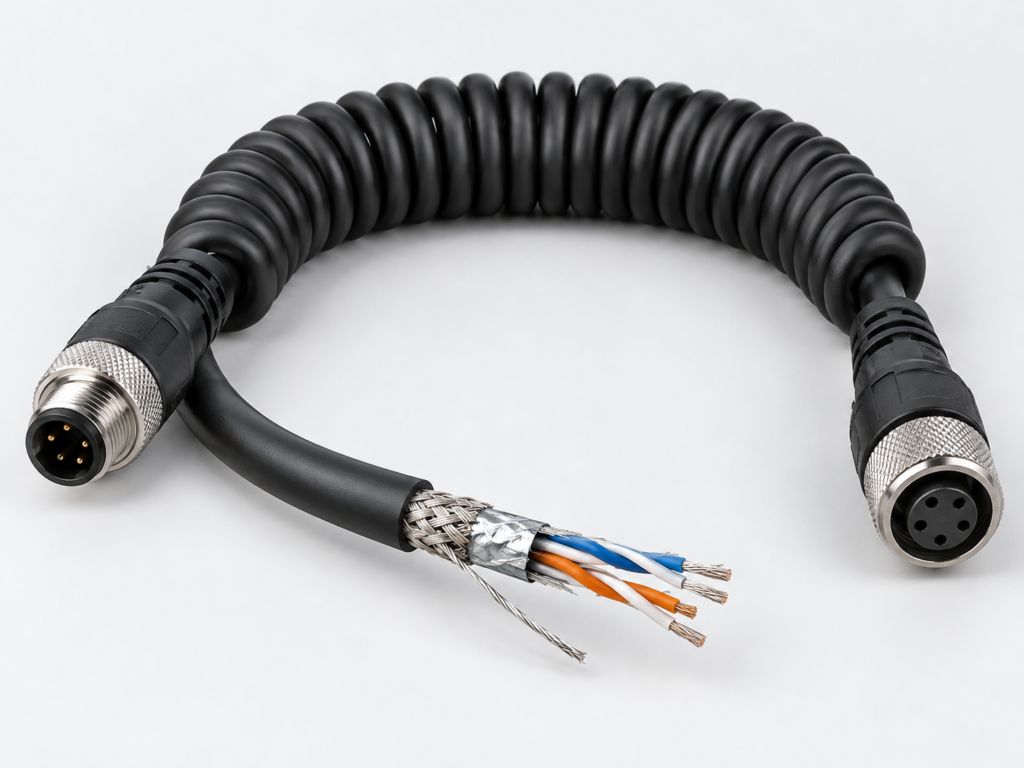
Quick answer: A shielded TPU coiled cable combines an extendable cable form with a shielding construction selected for signal integrity or noise-control requirements. Nexharn Connectivity reviews the signal type, power conductors, shielding method, grounding approach, coil dimensions, connector termination, movement and test criteria before sampling. Shielding performance depends on the complete design and should never be assumed from the presence of foil or braid alone.
Request a Custom Quote | Discuss Your Application
Shielded TPU Coiled Cable Product Overview
Shielded coiled cables require coordination between conductor layout, shield coverage, connector design and mechanical movement. Coiling can change geometry and stress the shield during repeated extension. Buyers should identify the signal, frequency range, surrounding interference sources, grounding strategy and acceptable test method so the supplier can propose a practical construction.
Typical Applications
- Sensors, encoders and measurement instruments
- Barcode scanners and industrial handheld devices
- Machine controls and robotic peripheral equipment
- Low-voltage power combined with signal circuits
- Equipment operating near motors, drives or other noise sources
Customization Options
- Foil, braid, drain wire or combined shielding options
- Twisted pairs and conductor arrangement
- Shield termination at one or both ends
- Connector shell and grounding configuration
- Coil dimensions, TPU hardness and straight tails
- Continuity, shielding and application-specific test requirements
Technical Specifications
| Number of Conductors | Confirmed according to application |
|---|---|
| Conductor Size | Customizable after current and signal review |
| Conductor Material | Flexible stranded copper options |
| Shielding | Optional where required |
| Cable Outer Diameter | Depending on cable construction |
| Jacket Material | TPU grade confirmed for application |
| Coil Outer Diameter | Customizable |
| Retracted Length | Customizable |
| Extended Length | Defined as normal working extension |
| Straight Tail Length | Customizable at both ends |
| Connector Type | Open end, standard or custom connector |
| Rated Voltage | Confirmed according to complete construction |
| Rated Current | Confirmed according to conductor, length and connector |
| Operating Temperature | Confirmed according to selected materials |
| Color | Standard or custom color discussion |
| Logo and Label | Optional |
| Testing Requirement | Agreed before sampling |
Cable Structure and Construction Options
Options may include aluminum foil with drain wire, copper braid, or a combined foil-and-braid system. Twisted pairs may be used where appropriate. The shield must be terminated deliberately at the connector or cable end, and a TPU jacket protects the moving assembly. Each shielding method has tradeoffs in flexibility, diameter, cost and termination complexity.
Tradeoffs should be reviewed rather than hidden. Increasing conductor size or adding shielding may increase cable diameter and weight. A tighter coil can increase stress, while a longer extension can affect voltage drop, return force and service life. Nexharn confirms the proposed construction and sample acceptance plan before mass production.
Why TPU for This Application
TPU supports a flexible and abrasion-resistant outer surface for moving equipment, while the internal shield addresses electrical noise requirements. The mechanical design must avoid excessive stress on foil, braid and drain wires. A larger coil or controlled working extension may be needed to protect the structure during repeated use.
Testing and Quality Control
Test requirements and acceptance criteria are confirmed before sampling. Production inspection follows the approved drawing, sample and order specification.
- Continuity and pinout inspection
- Shield continuity and termination verification
- Insulation and electrical testing as specified
- Dimensional, stretch and rebound checks
- Application-specific noise or signal testing when criteria are supplied
- Connector, strain-relief and visual inspection
Information Required for Quotation
For an efficient engineering review, send the target application, wiring or pinout, electrical requirement, natural coil length, normal working extension, coil outside diameter, straight tail lengths, connector details, working environment, estimated quantity, packaging and destination market. A drawing is helpful but not mandatory; equipment photos, an existing sample or a dimensioned sketch can be used to begin discussion.
Send Us Your Drawing | Download RFQ Preparation Tools
Buyer FAQ
Which shielding option is best?
There is no universal choice. Foil, braid and combined shielding differ in coverage, flexibility, diameter, termination and cost. Selection depends on signal and environment.
Can shielding guarantee a specific EMI result?
No. Results depend on cable construction, shield termination, connector, grounding, equipment and test setup. Acceptance criteria should be defined before sampling.
Can power and signal conductors share the same coiled cable?
Sometimes, but conductor separation, current, signal sensitivity, shielding and connector pinout must be reviewed. Separate cables may be preferable in demanding applications.
Should the shield be connected at both ends?
That depends on the system grounding strategy and noise environment. Nexharn follows the buyer’s approved wiring and termination requirements.
What should be sent for quotation?
Send signal details, wiring diagram, shielding request, grounding plan, coil dimensions, connector, movement, environment, quantity and test criteria.
Related Products and Technical Guides
- TPU Coiled Cable product range
- Custom TPU spiral cable manufacturing
- Seven specifications to confirm before RFQ
- TPU versus PVC coiled cable buyer guide
Request a Custom Quote
Send your drawing, sample photo, target dimensions, quantity, application and packaging needs. Nexharn Connectivity will review specification gaps, suggest a practical sample route and reply with quotation guidance.
Need a custom TPU coiled cable? Send a drawing, sample photo or basic requirements for review.
MOQ and Lead Time
MOQ is quoted after the conductor construction, TPU grade, connector, tooling, testing and packaging are reviewed. Sample and production lead times are estimated after the drawing revision, material availability, quantity and approval route are confirmed. Request written project terms; no fixed MOQ or delivery promise applies to every custom cable.
Testing and Custom-Option Resources
For project-specific test methods, equipment and acceptance records, review TPU cable testing and quality equipment. Use the RFQ, sample approval and packaging worksheets to describe custom conductor, connector, coil geometry, shielding, labels and pack options before quotation.
Compare TPU coiled cable types or send your drawing for MOQ and lead-time review.
Related TPU Coiled Cable Applications
Compare Medical Equipment Coiled Cable, Test Instrument TPU Coiled Cable for nearby equipment and circuit requirements. Use the TPU coiled cable application guide to browse the complete application range.
View all custom TPU coiled cables or send your drawing and application requirements.
Buyer resource: Before sampling, review the EMI, drain wire and grounding checklist for shielded TPU coiled cables.